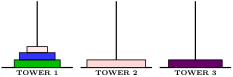
Activity 8.1.A Towers of Hanoi Puzzle.
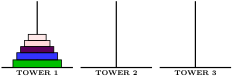
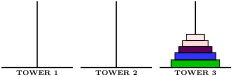
Given a disks of various diameters stacked in order on the first of three towers (pegs) as shown in Figure 8.1.2, it is only physically possible to lift the top disk up off any peg and put it down on another peg. Your goal is to move the entire tower of disks from the first tower to the third tower subject to two rules:
-
Rule 1: You may only move one disk at a time.
-
Rule 2: You may not put a larger disk on top of a smaller one.
-
Play Towers of Hanoi. You can move a disk by clicking on it and dragging it to another peg. Solve the puzzle for three disks.
-
Solve the puzzle for four disks without using the solve button.
-
Now, use the solve button to solve the puzzle for four disks. Keep track of when and where the largest disk moves. Where are the other disks when it moves? Hint: The largest disk moves once.
-
The minimum number of moves to solve the puzzle with three disks is seven. To solve the puzzle for four disks we need to move the top three disks, then the largest disk, and then we need to move the top three disks again. Explain why this strategy gives a solution to the puzzle with four disks in\begin{equation*} 7+1+7=15 \end{equation*}moves.
-
Use the solve button to solve the puzzle for four disks again and look for the minimum number of moves.
-
Generalize our strategy from (d) to guess how many moves it will take to solve the puzzle with five disks.
-
Use the solve button to check your answer to (f).
-
Consider the sequence \(h\) where \(h_n\) is the minimum number of moves needed to solve the puzzle with \(n\) disks for \(n \ge 1\text{.}\) The minimum number of moves needed to solve the puzzle with \(n-1\) disks would then be \(h_{n-1}\text{.}\) Make a conjecture about a rule for \(h_n\) in terms of \(h_{n-1}\text{.}\)
-
We saw that \(h_3=7\text{,}\) \(h_4=15\text{,}\) and \(h_5=31\text{.}\) Use the solve button to calculate \(h_6\) and \(h_7\text{.}\)
-
Based on the numbers from (i), make a conjecture about an explicit rule for \(h_n\text{.}\)