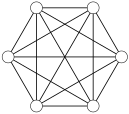
We start by working on our first puzzle. You will see puzzles throughout the textbook. Puzzles are inquiry-based activities designed to foreshadow, reinforce, or extend important course concepts; provide practice transferring your mathematical knowledge to new contexts; develop your critical thinking and proving skills; show you important or famous problems; and be fun. If you have seen a puzzle before, do not spoil the fun for classmates who have not seen the puzzle yet. The best way to do this is to stay quiet or ask questions, but not reveal answers.
In discrete mathematics, we frequently look for patterns. For example, there is one integer in the set
\(\{0\}\text{,}\) two integers in the set
\(\{0,1\}\text{,}\) three integers in the set
\(\{0,1,2\}\text{,}\) four integers in the set
\(\{0,1,2,3\}\text{,}\) and so on. In general, there are
\(n+1\) integers in the set
\(\{0,1,2,3, \ldots, n\}\text{.}\) Once we find a pattern, we often
conjecture, state an observation that is not (yet) known to be true or false. You can think of a conjecture as an educated guess. The puzzles, including this first puzzle, activities, and exercises in this textbook often ask you to practice conjectures.
After the puzzle, we discuss the field of discrete mathematics, introduce some features of this textbook, and share tips for success in learning discrete mathematics.
Subsection 1.1.B What is Discrete Mathematics?
What is discrete mathematics?
Discrete means “individually separate and distinct,” or, in the context of mathematics, objects that can be counted or listed
Google Dictionary “discrete”
.
Discrete mathematics is often defined by what it is not. For example, it is not
continuous mathematics, which includes real numbers (decimals), real-valued functions, and all of the calculus. Although this textbook assumes that you have seen some algebra, any occasional exercise that uses calculus is clearly marked so that courses that do not require calculus can skip those exercises.
Discrete mathematics by itself is not a branch of mathematics, but rather a part of every branch of mathematics. Therefore, each chapter in this textbook has its own flavor. For example,
Chapter 2 introduces enumerative combinatorics, which is a fancy name for counting. We tried our hand at counting in
Activity 1.1.A. In
Chapter 3 and
Chapter 4 we introduce two additional branches of discrete mathematics: combinatorial graph theory, which is the study of objects like the graph in
Figure 1.1.3, and number theory, which is the study of integers. The number of handshakes in
Activity 1.1.A is an example of a type of integer studied in number theory.
The context of discrete mathematics is a convenient place to study the foundation of mathematics. These foundations include the logic we use to explain our reasoning and to write proofs, as in
Chapter 5. They also include the study of functions, sets, and relations which we visit in
Chapter 6 and
Chapter 7. These topics are called foundational because all theoretical mathematics is built on these topics.
Computers can only do discrete mathematics, so we often say that discrete mathematics is the mathematics of computer science. The fundamental building block of computer science is recursion, which is a definition or process that uses itself or a smaller version of itself. We introduce recursion in
Chapter 8 and apply recursions to study sums and products in
Chapter 9. We have already seen sums in
Activity 1.1.A and we will take a peek at recursions in
Activity 2.1.A in
Section 2.1.
Subsection 1.1.C Learning Discrete Mathematics
What are the secrets to learning discrete mathematics? Before we get into specific suggestions for this course, try this activity.
Activity 1.1.B Getting good at something.
-
Take a moment to think or write about the following two questions.
-
What is something you are good at?
-
How did you get good at it?
-
Share your answers with a classmate or two.
-
What do your answers have in common?
-
What could you do to get good at mathematics?
While listening to and watching an expert, such as your professor, introduce concepts and demonstrate how to solve problems is often a comfortable way to start learning, the most important way to learning mathematics is to work with concepts and solve problems yourself.
Start by completing the activities within each section. These activities introduce core concepts and techniques and challenge you to explore mathematics in more depth. If you do these activities with your classmates in class, you can get feedback on your work from them and perhaps from the professor or a teaching assistant. If not, or if you miss class, read the textbook to help you do the activities. Often there are key notes, a very similar example, or even a solution.
Next, review your class notes or read the textbook to reinforce what you have learned. After that, work on the exercises at the end of each section. You might mistakenly think that you need to learn the material in order to complete the exercises, but it is actually the other way around that you need to complete the exercises in order to learn the material.
There are four types of exercises in this textbook.
-
Practice exercises help you learn key vocabulary, facts, and techniques.
-
Understand exercises challenge you to apply key concepts and techniques in greater depth.
-
Recap exercises ask you to summarize what you have learned.
-
Explore exercises connect what you have learned to new applications, involve conjectures or proofs, or introduce related topics beyond what is presented.
I encourage you to complete all the practice exercises and recap exercises, even if some are not assigned.
As you work on activities and exercises, get in the habit of receiving feedback on your work so that you know if you are understanding the concepts and solving problems correctly. In class, you might get feedback from classmates or the professor. If someone grades your work, be sure to read the grader’s comments for feedback. If your work is not graded, connect with a classmate to compare answers and follow-up by attending help sessions such as your professor or teaching assistant’s office hours or tutoring sessions.
In addition, this textbook includes answers and hints for some of the exercises to help you verify your own work. Resist the temptation to peek before you have tried the problem on your own first. There are likely a few typos in these answers and hints, so please let your professor know if you find an occasional error.
We all get stuck at times, and it can be frustrating. Do not be surprised if you have difficulty completing the explore exercises or are not even sure how to start. While it can be tempting at the moment to look for videos or online help tools, often it is faster and better to work with a classmate or attend a help session connected to your course. Be sure to follow your professor’s rules about what forms of help are acceptable for your course and follow all academic honesty policies. Whatever those policies are, never copy the work of another student or copy a solution you found on the Internet — not only might that behavior compromise your integrity, but you would miss the chance to figure out the mathematics for yourself!
Another hint involves making mistakes, which happens to all of us. Think about your experience working on
Activity 1.1.A. Both Mateo and Kierra had incorrect answers that were partially correct and easily fixed. Maybe you or someone in your group made the same mistakes. Although it can be tempting to discard a mistake, I encourage you to think of mistakes as partial solutions and try to fix them.
The number one secret to success in this class is to form a study group with your classmates. You do not have to become friends, although perhaps you will, just meet regularly to help each other in the course. Getting help from others and helping others both build your understanding. Look for other students who study at similar times, and if there is a study area near your professor’s office or classroom, go study there.
Near the end of each semester, we ask students to offer advice to future students. Here is some of what they say.
\(\checkmark\) Go to class.
\(\checkmark\) Start your homework right after class so you have time to ask for help if you get stuck.
\(\checkmark\) Don’t forget to turn in your homework on time.
\(\checkmark\) There’s a lot of homework and some of the exercises are super difficult, so do what you can. It’s okay to not get everything done.
\(\checkmark\) Get to know other students so you can work together, at least to check your work.
\(\checkmark\) Go to the professor’s office hours. They’re not as scary as you think. Plus, office hours are part of their job, so you paid for their help.
\(\checkmark\) Don’t fall behind but, if you do, ask the professor for advice on catching up.
\(\checkmark\) A study schedule is really helpful.
\(\checkmark\) Actually study for the quizzes/exams.
\(\checkmark\) Be prepared to work hard, but you will learn a lot and maybe even get an A.
\(\checkmark\) You got this!
Finally, know that you belong in this course. This course is designed for students studying mathematics, computer science, data science, information systems, or any science, but anyone who wants to have some fun with mathematics or meet a mathematics requirement is equally welcome. If you have always done well in your mathematics classes, then you will probably do well in this class, but if you have not done well in mathematics classes, give this course a chance. This class is quite different from high school algebra, and you may be good at it. It is okay if you have not taken calculus or precalculus or if your algebra is rusty (and whose algebra is not rusty?) as we introduce all the algebra you need in the course as we go. Get ready to do mathematics!