\(\newcommand{\newpara}{}
\newcommand{\nats}{\mathbb{N}}
\newcommand{\subcountawry}{\bf{When\ Counting\ Goes\ Awry}}
\newcommand{\seccountingstepscases}{\bf{Counting\ with\ Steps\ and\ Cases}}
\newcommand{\subalgfac}{\bf{Algebra:\ Factorials}}
\newcommand{\seccountingsubsets}{\bf{Counting\ Subsets}}
\newcommand{\secbitstrings}{\bf{Counting\ Bit\ Strings}}
\newcommand{\subhs}{Counting Handshakes}
\newcommand{\circled}[1]{\tikz[baseline=(char.base)]{\node[shape=circle,draw,inner sep=2pt] (char) {#1};}}
\newcommand{\xcircle}[1]{\circled{#1}}
\newcommand{\subdiscrete}{What is Discrete Mathematics?}
\newcommand{\sublearning}{Learning Discrete Mathematics}
\newcommand{\exerR}{Recap}
\newcommand{\subcountingawry}{When Counting Goes Awry}
\newcommand{\exerP}{Practice}
\newcommand{\subfactorials}{Algebra: Factorials}
\newcommand{\exerU}{Understand}
\newcommand{\subsubsetschoose}{Subsets and the Binomial Coefficients}
\newcommand{\exerE}{Explore}
\newcommand{\subcombinecount}{Combining Counting Techniques}
\newcommand{\subproofscountnosums}{Proof Format: Combinatorial Proof}
\newcommand{\subbitstrings}{Bit Strings}
\newcommand{\subcountbitstrings}{Number of Bit Strings}
\newcommand{\subrephrasingsubset}{Detour: Rephrasing the Question}
\newcommand{\subexplog}{Algebra: Exponential Notation and Logarithms}
\newcommand{\subbridges}{Crossing Bridges}
\newcommand{\subdefngraph}{The Definition of a Graph}
\newcommand{\subgraphcomp}{Graph Complements}
\newcommand{\subdegseq}{Degree Sequences}
\newcommand{\substdgraphs}{Standard Graphs}
\newcommand{\subadjmat}{The Adjacency Matrix of a Graph}
\newcommand{\subcolormaps}{Coloring Maps}
\newcommand{\subchromatic}{Coloring Graphs}
\newcommand{\subgraphconj}{Graph Conjectures}
\newcommand{\subplanarity}{Planarity}
\newcommand{\subisograph}{Isomorphic Graphs}
\newcommand{\subgraphtrees}{Subgraphs and Trees}
\newcommand{\subnonisograph}{Nonisomorphic Graphs}
\newcommand{\subgraphclassification}{Graph Classification}
\newcommand{\subrobots}{Detour: Robots}
\newcommand{\sublockers}{Opening and Closing Lockers}
\newcommand{\subevenodd}{Even and Odd Integers}
\newcommand{\subdivides}{Divisibility}
\newcommand{\subfractions}{Algebra: Equivalent Fractions}
\newcommand{\subdivalg}{The Division Algorithm, \fn{div}, and \fn{mod}}
\newcommand{\subpolys}{Algebra: Polynomials}
\newcommand{\subpffcases}{Proof Format: Proof by Cases}
\newcommand{\subnotlast}{Not Last Game}
\newcommand{\submod}{The Mod Clock}
\newcommand{\subzn}{The Integers mod $n$}
\newcommand{\subprimes}{Primes and Composites}
\newcommand{\subprimefact}{Prime Factorization}
\newcommand{\subcountdiv}{Detour: Listing and Counting Divisors}
\newcommand{\subgcd}{Greatest Common Divisor}
\newcommand{\subea}{The Euclidean Algorithm}
\newcommand{\subcoprime}{Coprime Integers}
\newcommand{\subandor}{And and Or}
\newcommand{\subpffandor}{Proof Formats: $\land$ and $\lor$ by Cases}
\newcommand{\subequivneg}{Logical Equivalence and Negations}
\newcommand{\subpffcontra}{Proof Format: Contradiction}
\newcommand{\subsetgame}{The Game SET}
\newcommand{\subquant}{Quantifiers}
\newcommand{\subpffquants}{Proof Formats: $\forall$ and $\exists$}
\newcommand{\subcex}{Negating Quantified Statements and Counterexamples}
\newcommand{\subifthen}{Promises: Conditional Statements}
\newcommand{\subpffifthen}{Proof Format: Direct Proof of $\to$}
\newcommand{\subnegcond}{Broken Promises: Negating Conditional Statements}
\newcommand{\subpfforimplication}{Proof Formats: Proof of $\lor$ Using Implication}
\newcommand{\subconv}{The Converse and Biconditional Statements}
\newcommand{\subpffiff}{Proof Format: $\leftrightarrow$}
\newcommand{\subcp}{The Contrapositive}
\newcommand{\subpffcp}{Proof Format: $\to$ Using the Contrapositive}
\newcommand{\subequiv}{Logical Equivalence}
\newcommand{\subneg}{Simplifying Negations}
\newcommand{\subinference}{Logical Inference}
\newcommand{\subinfsetsnumbers}{Infinite sets of numbers}
\newcommand{\subdefnfnnotation}{Function Notation and Vocabulary}
\newcommand{\subpiecewise}{Piecewise-defined Functions}
\newcommand{\subfndotgraphs}{Dot Diagrams and Graphs of Functions}
\newcommand{\subfloorceiling}{Floor and Ceiling}
\newcommand{\subnumberfn}{Number-theoretic Functions}
\newcommand{\subfngraphs}{Graph-theoretic Functions}
\newcommand{\subbitstringfunctions}{Functions Involving Bit Strings}
\newcommand{\suborderedpair}{Ordered Pairs and the Definition of Function}
\newcommand{\subpairing}{Pairings}
\newcommand{\subonetooneonto}{One-to-one and Onto}
\newcommand{\subperms}{Permutations}
\newcommand{\subinverses}{Inverse Functions}
\newcommand{\subpffunique}{Proof Format: Uniqueness}
\newcommand{\subdefnseq}{The Definition of Sequence}
\newcommand{\submodelseq}{Modeling with Explicitly-defined Sequences}
\newcommand{\subseqprimes}{Detour: Sequences Involving Primes}
\newcommand{\subelements}{Elements of a Set}
\newcommand{\subsetbuild}{Set-Builder Notation}
\newcommand{\subsetops}{Set Operations}
\newcommand{\subsubsets}{Subsets of a Set}
\newcommand{\subbsrepsubset}{Bit String Representation of Subsets}
\newcommand{\subsetsofsets}{Sets of Sets}
\newcommand{\subsetfn}{Detour: Set-theoretic Functions}
\newcommand{\subdefnpartition}{The Definition of Partition}
\newcommand{\subselfconj}{Conjugate Partitions}
\newcommand{\subbulgsol}{Collecting Coins}
\newcommand{\subcartprod}{The Cartesian Product of Sets}
\newcommand{\subfncartprod}{Functions Involving Cartesian Products}
\newcommand{\subdefnrelation}{Relations and Their Representations}
\newcommand{\subrelppty}{Properties of Relations}
\newcommand{\subequivclass}{Equivalence Relations and Equivalence Classes}
\newcommand{\subcongmod}{Congruence mod $n$}
\newcommand{\subhanoi}{The Towers of Hanoi}
\newcommand{\subrecdefseq}{Recursively-defined Sequences}
\newcommand{\subntr}{Modeling with Recursively-defined Sequences}
\newcommand{\subpffmathind}{Proof Format: Mathematical Induction}
\newcommand{\subalgind}{Algebra: Evaluating $f(n-1)$}
\newcommand{\subpffindseq}{Proof Format: Special Case of Mathematical Induction for Proving an Explicit Rule for a Recursively-defined Sequence}
\newcommand{\submatpowers}{Matrix Products and Powers}
\newcommand{\subpffindmatrix}{Proof Format: Special Case of Mathematical Induction for Proving an Explicit Formula for the Power of a Matrix}
\newcommand{\subgroups}{Finite Groups}
\newcommand{\subproperbs}{Proper Bit Strings}
\newcommand{\subrecsets}{Recursively-defined Sets}
\newcommand{\subrecgraphs}{Recursively-defined Graphs}
\newcommand{\subfib}{The Fibonacci Sequence and Higher Order Recursions}
\newcommand{\submodelhigher}{Modeling with Higher Order Recursions}
\newcommand{\subfibpatterns}{Detour: Fibonacci Patterns and Proof}
\newcommand{\subpffstrongind}{Proof Format: Strong Mathematical Induction}
\newcommand{\subhowmanysq}{Counting Squares}
\newcommand{\subfactrep}{Factorial Representations}
\newcommand{\subsigmapi}{Sum and Product Notation}
\newcommand{\subbaseb}{Base $b$ Representation}
\newcommand{\subbinary}{Binary Representation}
\newcommand{\subhex}{Hexadecimal Representation}
\newcommand{\subhexforbinary}{Hex as a Shorthand for Binary}
\newcommand{\subsumconj}{Sum Conjectures}
\newcommand{\subprodconj}{Product Conjectures}
\newcommand{\subsumfib}{Detour: Fibonacci Sums}
\newcommand{\subfactorpolys}{Algebra: Factoring Polynomials}
\newcommand{\subarithtri}{The Arithmetic Triangle}
\newcommand{\subpascalpatterns}{Patterns in the Arithmetic Triangle}
\newcommand{\subbinomthm}{The Binomial Theorem}
\newcommand{\subfactorialbinom}{Explicit Formula for Binomial Coefficients}
\newcommand{\subpffsumproofsind}{Proof Format: Special Case of Mathematical Induction for Proving Sum and Product Formulas}
\newcommand{\subpffcombsums}{Proof Format: Combinatorial Proof of Sums}
\newcommand{\subspecialsum}{Detour: Special Sums}
\newcommand{\subfracalg}{Algebra: Fraction Arithmetic}
\newcommand{\subhotelinf}{Hotel Infinity}
\newcommand{\subdefndiscrete}{The Definition of Discrete}
\newcommand{\seclisting}{Organized Listing}
\newcommand{\vocab}{\textbf}
\newcommand{\str}{\texttt}
\newcommand{\fn}{\texttt}
\newcommand{\bs}{\texttt}
\newcommand{\lt}{<}
\newcommand{\gt}{>}
\newcommand{\amp}{&}
\definecolor{fillinmathshade}{gray}{0.9}
\newcommand{\fillinmath}[1]{\mathchoice{\colorbox{fillinmathshade}{$\displaystyle \phantom{\,#1\,}$}}{\colorbox{fillinmathshade}{$\textstyle \phantom{\,#1\,}$}}{\colorbox{fillinmathshade}{$\scriptstyle \phantom{\,#1\,}$}}{\colorbox{fillinmathshade}{$\scriptscriptstyle\phantom{\,#1\,}$}}}
\)
Section5.2Quantifiers
In Activity 5.1.A there were statements involving variables in which the truth of the statement depended on whether the statement was about all values, some values, or no values of the variables. Each of the words “all”, “some”, and “no” has a specific meaning in mathematics and computer science. In this section, we consider such quantifiers and their negations and formally introduce the idea of a counterexample. We also look at how to prove quantified statements.
The game SET! is produced by SET Enterprises™, part of Monster Play. You can learn to play SET! online. There is a lot of information about this game on the Internet. Resist the temptation to use any resources to find answers to this (or any) activity. The fun part is figuring it out for yourself!
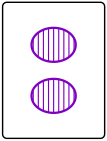
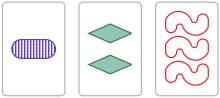
In the game SET!, there is a deck of special cards. Each card has the image of some number of a colored shape with some level of shading. If there is more than one shape on a card, the others shapes on the card are repeats of that shape with the same color and level of shading. For example, there is a card that has two striped, purple ovals, as shown in Figure 5.2.2.
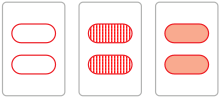
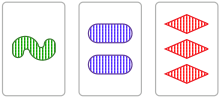
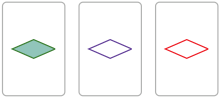
There are four characteristic of the image on each card: number, shading, color, and shape. Each characteristic has three options as summarized in Table 5.2.3.
A set of three cards is a SET if for each of the characteristics either the images on the three cards all agree or are all different. That is, all four of the following conditions must be met.
All three cards have the same number or there is one with 1, one with 2, and one with 3.
Given a pair of cards, explain how we can find a third card that makes a SET with the given pair. Be sure to explain in general (tell someone step-by-step how to find the missing third card.)
In the game SET!, a set of three cards forms a SET if for each characteristic, all the cards agree or none of the cards agree. A set of three cards is not a SET if, for some characteristic, the cards have two of one kind and one of a different kind. Part of the challenge of learning the game is grappling with words like “each”, “all”, “none”, and “some” which are examples of quantifiers.
Quantifiers can be defined on any set. Throughout this definition, our examples use the set of integers.
We indicate that a statement \(P\) depends on a variable \(n\) by writing \(P(n)\) instead of \(P\text{.}\) The notation \(P(n)\) is predicate notation. For example, if \(P(n)\) is the statement “the integer \(n\) is odd”, then \(P(3)\) is the statement “the integer \(3\) is odd”, which is true, but \(P(10)\) is the statement “the integer \(10\) is odd”, which is false.
The universal quantifier, denoted \(\forall\text{,}\) means “for all”.
The statement \(\forall n P(n)\) is the statement “\(P(n)\) is true for all values of \(n\)”. For example, if \(P(n)\) is the statement “the integer \(2n\) is even”, then \(\forall n ~ P(n)\) is the statement “every integer of the form \(2n\) is even”, which is true. On the other hand, if \(Q(n)\) is the statement “\(3 \mid n\)”, then \(\forall n ~ Q(n)\) is the statement “every integer is divisible by three”, which is false because, for example, 17 is not divisible by three.
The statement \(\forall n(\neg P(n))\) means \(P(n)\) is false for all values of \(n\text{.}\) For example, if \(R(n)\) is the statement “the integer \(2n+1\) is even”, then \(\forall n (\neg R(n))\) is the statement “no integer of the form \(2n+1\) is even”, which is true.
The existential quantifier, denoted \(\exists\) means “there exists.”
The statement \(\exists n ~ P(n)\) means that \(P(n)\) is true for some value(s) of \(n\text{.}\) For example, if \(Q(n)\) means that \(3 \mid n\text{,}\) then \(\exists n ~ Q(n)\) means that some integer is divisible by three, which is true because, for example, 12 is divisible by three.
The statement \(\exists n (\neg P(n))\) means that \(P(n)\) is false for some value(s) of \(n\text{.}\) For example, if \(Q(n)\) means \(3 \mid n\text{,}\) then \(\exists n (\neg Q(n))\) means that some integer is not divisible by three, which is true because, for example, 17 is not divisible by three.
Words and phrases that indicate an existential quantifier include: at least one, can, contains, has, possible, some, someone, sometimes, there exist, there exists there is, there are, etc.
Note that some words and phrases that indicate the existential quantifier are plural, but it takes only one value of \(n\) where \(S(n)\) is true to make the statement \(\exists n ~ S(n)\) true. For example, in mathematics, some means at least one.
Universally quantified statements are sometimes written without an explicit quantifier. For example, we might say \(2n\) is even when we really mean \(2n\) is even for all integers \(n\text{.}\)
In each statement, find a word or phrase that indicates a quantifier and say which: \(\forall\) or \(\exists\text{.}\) In some parts, both quantifiers are involved. (We saw these statements in Activity 5.1.A and Activity 5.2.B.)
There are three distinct digits whose sum is 23.
Solution.
The phrase “there are” indicates an existential quantifier \(\exists\text{.}\)
In the first sentence of Theorem 5.2.14 we present an example without any explanation of how we found that example. Mathematicians sometimes explain where the example came from, but that explanation is not a required part of the proof. Let’s look at a quick example.
Proof. Consider the cycle \(C_5\text{.}\) Recall that \(C_5\) has five vertices and five edges. Therefore, there is a graph that has five vertices and five edges, namely \(C_5\text{.}\)
The proof of a universally quantified statement is more complicated because we have to prove that the statement holds for all possible examples. In some cases, we can simply check every example.
In Section 4.3, we introduced the integers mod 5, \(\mathbb{Z}_5=\{0,1,2,3,4\}\text{.}\) In \(\mathbb{Z}_5\text{,}\) multiplication is defined by \(a \otimes b = ab \fn{ mod } 5\text{.}\) Prove that there is no solution to \(x^2=2\) in \(\mathbb{Z}_5\text{.}\) Note that \(x^2 = x \otimes x\text{.}\)
We can check each element of \(\mathbb{Z}_5\) to see if it is a solution. Our work is displayed in Table 5.2.17. Since none of the elements of \(\mathbb{Z}_5\) is a solution, we can conclude that there is no solution to \(x^2=2\) in \(\mathbb{Z}_5\text{.}\)
In the previous example, we were able to check all five possible examples. But if the list of possible examples is very long or infinite, it is not reasonable or possible to check every example, and it is not enough to just check some examples. Here is the proof format.
The proof begins by naming an arbitrary object, \(n\text{,}\) of the type described. This first sentence invites the reader to select any value of \(n\text{.}\) Next, we show that the statement is true for that particular but unknown \(n\text{.}\) Our proof must work for whatever value \(n\) the reader selected.
Proof. Let \(q\) be an integer. Then \(6q-10=2(3q-5)=2k\) where \(k=3q-5\) is an integer. By the definition of even, it follows that \(6q-10\) is even. Therefore, for every integer \(q\text{,}\) the integer \(6q-10\) is even.
Copy the following proof. Note that the phrase “there is” indicates an existentially quantified statement, so we use Theorem 5.2.14. Prove that there is an integer that has exactly four positive divisors.
Proof.
Consider the integer six. The positive divisors of six are 1, 2, 3, and 6. Thus, six has exactly four positive divisors. Therefore, there is an integer that has exactly four positive divisors.
Copy the following proof. Note that the phrase “for any” indicates a universally quantified statement, so we use Theorem 5.2.18. Prove \(n \mid n!\) for any integer \(n\text{.}\)
Proof.
Let \(n\) be an integer. Note that \(n!=n(n-1)!=nk\) where \(k=(n-1)!\) By the definition of divides, it follows that \(n \mid n!\) Therefore, \(n \mid n!\) for every integer \(n\text{.}\)
Many interesting mathematical statements involve both existential and universal quantifiers. Fortunately, we do not need new proof formats. Instead, we can nest proof formats one inside the other, as if they were Matryoshka dolls 1
See wikipedia Matryoshka doll.
or nested loops in computer programming. Try writing proofs that nest the proof formats for existentially and universally quantified statements.
Activity5.2.DProofs of mixed quantified statements.
Copy the following proof. Note that we use Theorem 5.2.18 and, within that format, we use Theorem 5.2.14. We have indented the lines to highlight the nesting. Prove that for any integer \(n\) there is an integer \(m\) such that \(n+m=100\text{.}\)
Edit the proof in (a) to prove that for any integer \(n\) there is an integer \(k\) such that \(n-k=100\text{.}\) Hint: Solve for \(k\) before starting to write the proof.
Copy the following proof. Note that we use Theorem 5.2.14 and, within that format, we use Theorem 5.2.18. Notice that we are nesting the quantifiers in the opposite order from (a). We have indented the lines to highlight the nesting. Prove that there exists an integer \(z\) such that \(zn=z\) for any integer \(n\text{.}\)
Edit the proof in (c) to prove that there exists an integer \(w\) such that \(wn=n\) for any integer \(n\text{.}\) Hint: Solve for \(w\) before starting to write to write the proof.
The last sentences of the proofs in Activity 5.2.D may seem repetitive. They are logically necessary and a good idea for you to write as you are first learning proofs, but in practice mathematicians often omit those final sentences.
Subsection5.2.ENegating Quantified Statements and Counterexamples
How do we prove that a quantified statement is false? To answer this question, we need to recognize the negations of quantified statements. You may want to revisit Activity 5.1.A and Activity 5.2.B to see if you can state these negations for yourself before reading on.
The statement \(\forall n ~ P(n)\) says \(P(n)\) is always true. The negation would say \(P(n)\) is not always true which is equivalent to saying \(P(n)\) is sometimes false.
The statement \(\exists n ~ P(n)\) says \(P(n)\) is sometimes true. The negation would say \(P(n)\) is never true which is equivalent to saying \(P(n)\) is always false.
By Theorem 5.2.24, to prove that a universally quantified statement is false, all it takes is one example where it is false. There is a special name for an example that shows that a universally quantified statement is false.
A counterexample is an example where a universally-quantified statement is false. For example, a counterexample to the false statement “Every square integer has exactly three positive divisors” from Activity 5.1.A(d) is the integer 16 because \(16=4^2\) is a square, but 16 has five positive divisors: 1, 2, 4, 8, and 16.
Each of the following universally quantified statements is false. Find a specific counterexample to each statement. Hints: It might help to write the negation. Make sure to use DeMorgan’s Laws Theorem 5.1.23 if the statement involves “and” or “or”.
While a counterexample is enough to prove that a universally quantified statement is false, to prove that an existentially quantified statement is false, we have to prove that a universally quantified statement is true using Theorem 5.2.18.
Play the game SET™. Invite friends to join you or play on your own. Note that once someone finds a SET, those three cards are removed and replaced by three new cards, which is how the in-person game works. Play for at least 15 minutes and tell me how that went for you.
Try to solve the Daily SET Puzzle . Note that each time you find a SET, it is recorded in a table on the side. There will be exactly six different SETs you can find. Cards may be repeated in different SETs. You have to wait until the next day to try it again. Try to solve this Daily Puzzle for at least 15 minutes (or until you solve it) and tell me how that went for you.
A plane is a collection of four cards that they can be grouped in two pairs where each pair is “missing” the same third card to create a SET. Give an example of a plane whose missing card is 2SPO shown in Figure 5.2.2.
Given one card, how many different SETs could it be in? Justify your answer. Caution: It is easy to count each SET twice by mistake. If so, just divide by two to get the correct count.
How many different SETs could be made from cards in the deck (not all at the same time). Explain your reasoning. Caution: It is easy to over count by mistake. If so, figure out what to divide by to get the correct count.
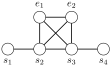
Consider the graph \(G\) drawn in Figure 5.2.34. Recall that a leaf is a vertex with degree one. For each statement about \(G\text{,}\) identify a word or phrase that indicates a quantifier and decide if each statement is true or false. Briefly justify your answer.
For any integer \(n\text{,}\) the statement \(T(n)\) means that \(n^2>n\text{.}\) Decide if each statement is true or false. Briefly justify your answers.
For any integer \(n\text{,}\) the statement \(S(n)\) means that \(n\) is greater than six and \(E(n)\) means that \(n\) is less than 11. For what value(s) of \(n\text{,}\) if any, is each statement true? Report your answer as a list, using \(\ldots\) to indicate an infinite set. No explanation required.
Give an example of predicates \(P(n)\) and \(Q(n)\) such that \(\forall n (P(n) \lor Q(n))\) is true, but \((\forall n~ P(n)) \lor (\forall n~ Q(n))\) is false.
Proof. Consider \(n=23\text{.}\) Note that \(23 > 20\) and 23 is prime because \(2 \nmid 23\text{,}\)\(3 \nmid 23\text{,}\) and \(\sqrt{23} \lt 5\text{.}\) (It is okay if you just wrote “23 is prime”.) Therefore, there is a prime greater than 20, namely 23.
Give an example to prove that the following statement is true: There is a 3-letter word where there are 3! ways to arrange the letters (not all of which have to be real words).
Give a counterexample to prove that the following statement is false: For any 3-letter word, there are 3! ways to arrange the letters (not all of which have to be real words.)
Use contradiction to prove that there are at least two vertices in \(G\) that have equal degree. Hint: Consider what would happen if the \(n\) vertices each had different degrees.
Each of the following statements is false. Provide a counterexample.
Consider the statement \(\fn{gcd}(a,2b) = \fn{gcd}(a,b)\text{.}\) Give an example of integers \(a\) and \(b\) where the statement is true and give a counterexample to show the statement is not true in general.
Consider the statement \(\fn{gcd}(a,2b) = 2\fn{gcd}(a,b)\text{.}\) Give an example of integers \(a\) and \(b\) where the statement is true and give a counterexample to show the statement is not true in general.
When is \(\fn{gcd}(a,2b) = \fn{gcd}(a,b)\) and when is \(\fn{gcd}(a,2b) = 2\fn{gcd}(a,b)\text{?}\) Your answers should involve \(a\) and \(b\text{.}\) Hint: Prime factorization.